
AI Robotics Engineering with AR Coding
Length: 2 weeks
Accreditation: Fully WASC Accredited (The Gold Standard in K-12 Education)
Prerequisite: None
DESCRIPTION
Welcome to the intersection of Sci-Fi and Reality, where Teen Engineers transform a Robot into an autonomous robot.
No experience needed—everyone learns at their own pace, with extra challenges for students who are ready for more.
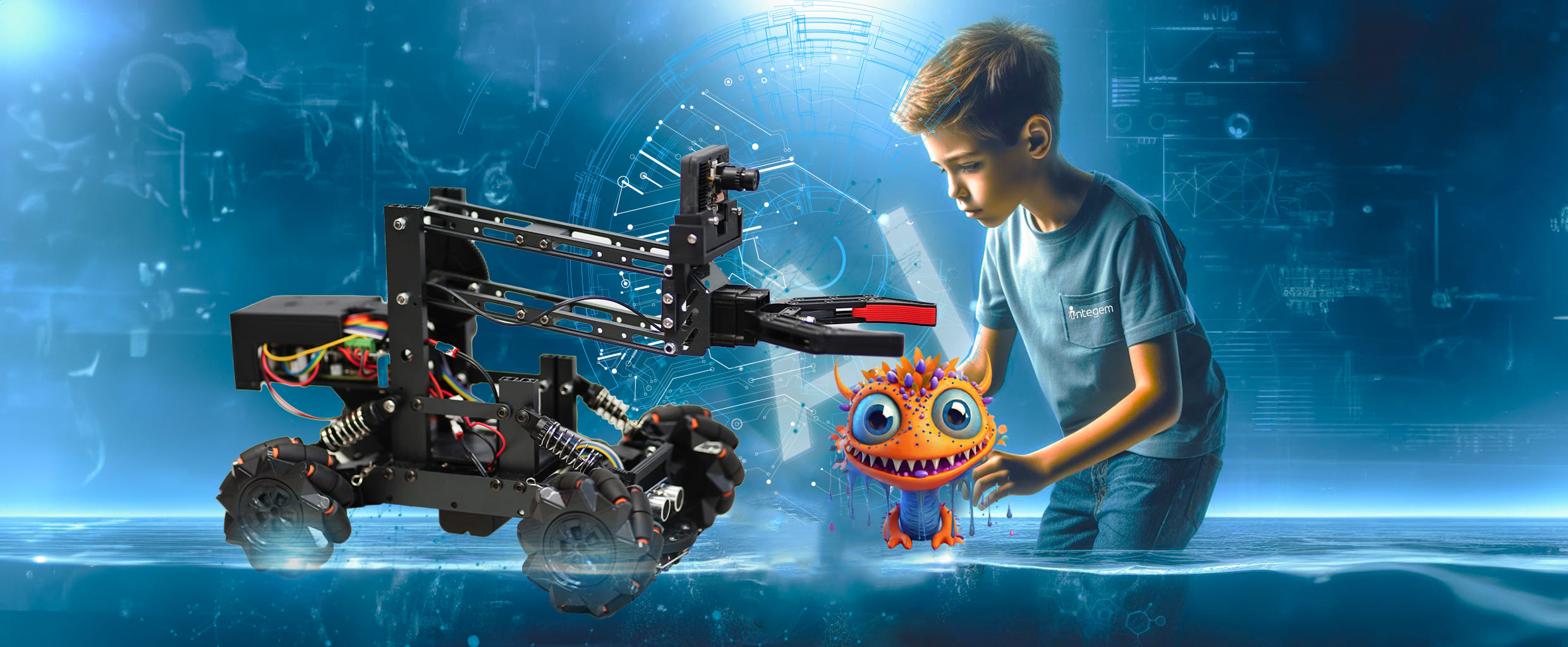
Week 1: Build the Robot Body. You will build a Mecha-Armed Robot, a futuristic rover capable of drifting sideways and grabbing objects. You will learn to control its movements with Python code.
Week 2: Build the Robot Brain. You will install an AI Integrated System, endowing your Robot with the "magic" of intelligence. Suddenly, it isn't just moving; it’s sensing, processing, and reacting.
Throughout the camp, you will use Holographic AR to merge two worlds. Imagine your Robot is deployed to repair a satellite in deep space. It is too dangerous for humans to go there, so you use AR to teleport yourself into the robot's environment. You appear right next to your robot in the digital world, guiding it through the mission while you remain safely at Earth Command.
Along the way, campers build creativity, critical thinking, and persistence as they debug and improve the AI robotics systems.
The Magic of AI + AR:
- Give It a Brain: Don't just push buttons. Learn how AI elevates a robot from a remote-controlled toy to a smart machine that can sense its surroundings.
- Partner in the Danger Zone: Use Holographic AR to teleport into simulated hazardous environments. Work side-by-side with your robot to solve puzzles that neither of you could solve alone.
- Invisible Connections: Use code to bridge the gap between the hardware you can touch and the software you can't see.
The Robot & Hardware:
- Robot: A Mecha Armed smart robot powered by Raspberry Pi PicoW (industry standard) technology, featuring programmable sensors, Mecha Arms, and Mecanum Wheels with Omni Directional Tires, to explore sophisticated sensor technologies and advanced control systems.
- AI Integrated System: This system, mountable on the smart robot, acts as the AI brain, endowing the robot with intelligence.
- Note: The smart robot hardware is provided for camp use, not to take home.
Course Modules:
- Part 1. Introduction to Robotics Mechanics
- Part 2. Introduction to Robotics Motor Controls
- Part 3. Introduction to Circuits
- Part 4. Introduction to Python Coding
- Part 5. Introduction to Robotics Sensors
- Part 6. Introduction to AR Coding for Robotics Control
- Part 7. Interactive AR Coding with Robotics Controls
- Part 8. Introduction to AI
- Part 9. Introduction to AI-Based Robotics Control
- Part 10. Interactive AR Experience Design with AI and Robotics
- Part 11. Design Your Own AI Robotics Control, and launch your robot remotely and teleport into your robot world with Holographic AR.
Play & Create: Enjoy a dynamic mix of hands-on engineering and fun indoor/outdoor camp activities.
Students will learn the following:
- Introduction to AI (Teen Level)
- Introduction to AI-based Robotics Design (Teen Level)
- Beginning to Intermediate Robotics Engineering (Teen Level)
- Beginning to Intermediate Robotics Coding (Teen Level)
- Intermediate Holographic AR design & logic (Teen Level)
- Fundamentals of Circuits (Teen Level)
- Python Coding (Teen Level)
- UI/UX (user interface/user experience) (Teen Level)
- Visual communication (Teen Level)
- Interactive storytelling (Teen Level)
- Debugging and Problem-solving (Teen Level)
- Design Thinking process based on Stanford University Design School curriculum (Teen Level)
⚠️ Essential Safety & Readiness Guide (Please Read) To ensure a successful experience, please ensure your teen is ready for the following:
- Respect the Tech: We use sensors, components, and tools. Students must handle equipment with care.
- Focus & Logic: Engineering requires patience. Students should be ready to troubleshoot and solve puzzles.
- Instruction: Following step-by-step engineering protocols is vital for safety and success.
Choose a Location
Select Location
San Francisco Bay Area
South Bay
SF & Peninsula
East Bay
Marin/North Bay
Los Angeles & Orange County
Irvine/Orange County
LA: South Bay
LA: Westside
LA: Eastside