
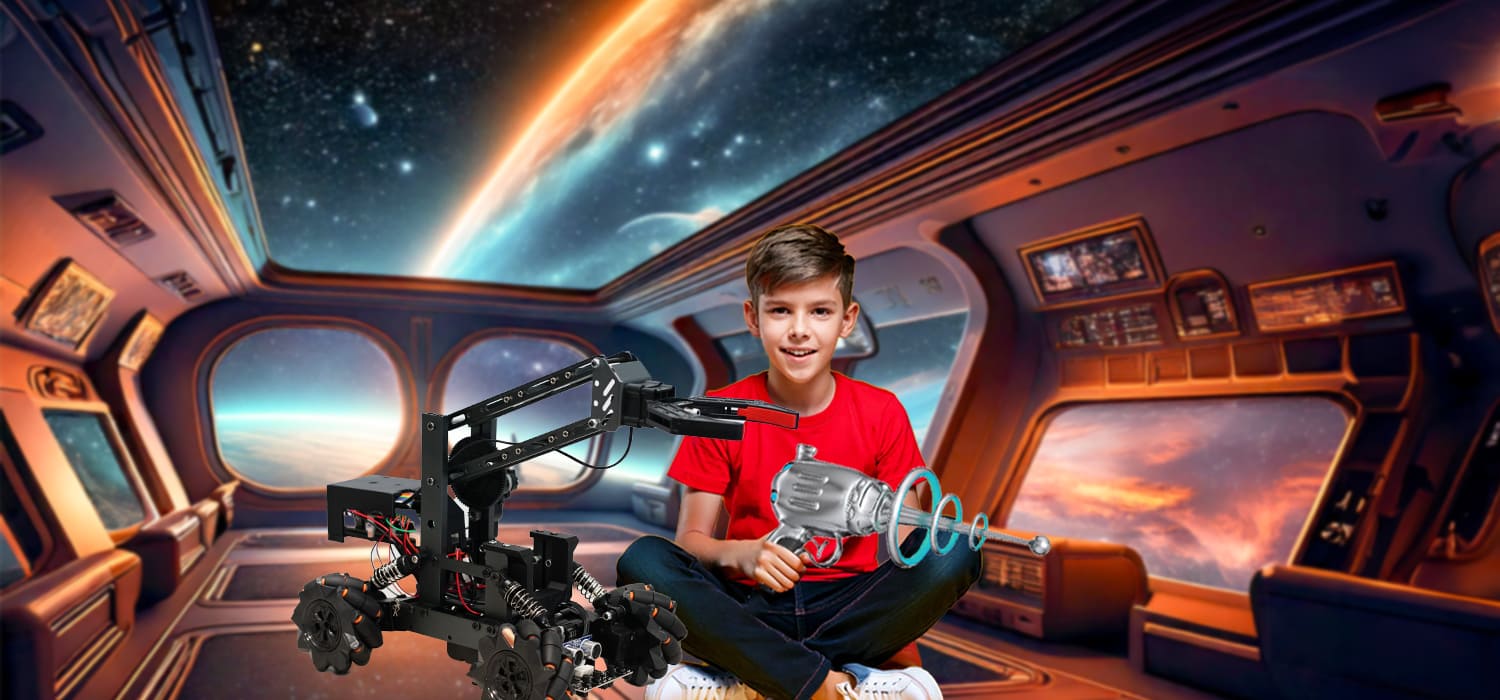
Robotics Engineering & AR Coding
Grades: Grade 3-5
Length: 2 weeks
Accreditation: Fully WASC Accredited (The Gold Standard in K-12 Education)
Prerequisite: None
DESCRIPTION
Welcome to the Robotic Engineering Academy! Young Engineers will dive into a captivating 2-week adventure where they delve into the mechanics of two different types of advanced robots.
No experience needed—everyone learns at their own pace, with extra challenges for students who are ready for more.
This isn't just about remote-controlled cars; it's about true engineering. In Week 1, students work with a Smart Sensor Robot, learning to code it to "see" and "feel" its surroundings. In Week 2, they level up to the Advanced Mecha Robot, featuring mechanical arms and special Omni-directional wheels (like a futuristic rover!). Throughout the camp, students combine their physical engineering with Holographic AR, teleporting into digital worlds to partner with their robots on exciting missions.
Along the way, campers build creativity, critical thinking, and persistence as they debug and improve the robotics capabilities.
Experience the Magic of Robotics + AR: We combine hands-on construction with immersive digital exploration.
- Hands-on Learning with Two Robots: Students get hands-on experience with two distinct robotic systems, progressing from sensor logic to advanced mechanical arms and movement.
- Omni-Directional Movement: In Week 2, students control a robot with special Mecanum wheels, allowing it to drift sideways and move in any direction—just like advanced industrial robots!
- Teleport to the Mission: Using Holographic AR, students don't just watch their robot; they become the mission commander. They can visualize their robot exploring a virtual galaxy or ocean floor while controlling it safely from the classroom.
The 2-Week Hardware Journey:
- Week 1: The Smart Scout: Students work with a robot powered by an ESP32 chip (industry standard). The focus is on Sensors—coding the robot to detect walls, follow lines, and avoid obstacles automatically.
- Week 2: The Mecha Rover: Students advance to a complex robot equipped with Mechanical Arms, Omni-Directional Wheels, and PicoW (industry standard). The focus is on advanced motion control and grasping objects.
- Note: The robot hardware is provided for camp use, not to take home.
What You Will Do:
- Code Intelligence: Use block-based coding to give your robot a "brain," teaching it to make decisions based on what its sensors see.
- Control the Arm: Program the mechanical arm to grab, lift, and move objects with precision.
- Drift & Drive: Learn the movement of Mecanum wheels, learning how to pilot a robot that can move sideways and diagonally.
- Navigate with AR: Create a digital environment for your robot and control it as it navigates through virtual hazards.
- Play & Learn: Enjoy a healthy balance of high-tech engineering with fun indoor/outdoor camp activities.
Students will learn the following:
- Computer, keyboard, mouse, and Internet skills (Young Level)
- Beginning to Intermediate Robotics Engineering: motor control, sensor control and sensing, robotics coding (Young Level)
- Beginning to Intermediate Robotics Coding (Young Level)
- Beginning to Intermediate Holographic AR concepts & Logics (Young Level)
- Beginning to Intermediate Holographic AR coding (Young Level)
- Introduction to Circuits (Young Level)
- UI/UX (user interface/user experience) (Young Level)
- Visual communication (Young Level)
- Interactive storytelling (Young Level)
- Debugging and Problem-solving (Young Level)
- Design Thinking process based on Stanford University Design School curriculum (Young Level)
⚠️ Essential Safety & Readiness Guide (Please Read) To ensure a safe and happy camp for our participants, please ensure your child is ready for the following:
- Respect the Tech: We use sensors and components. Students must be able to handle equipment gently; throwing or mistreating the robot is not permitted.
- Listening Skills: Robotics requires following specific steps. Students must be able to follow teacher instructions to prevent damage to the equipment and ensure safety.
- Focus & Patience: Engineering involves trial and error! Students should be ready to problem-solve when things don't go perfectly the first time.
Choose a Location
Select Location
San Francisco Bay Area
South Bay
SF & Peninsula
East Bay
Marin/North Bay
Los Angeles & Orange County
Irvine/Orange County
LA: South Bay
LA: Westside
LA: Eastside